
Sine Calibration and Metrology Training Program
Sine Calibration and Metrology Training Program
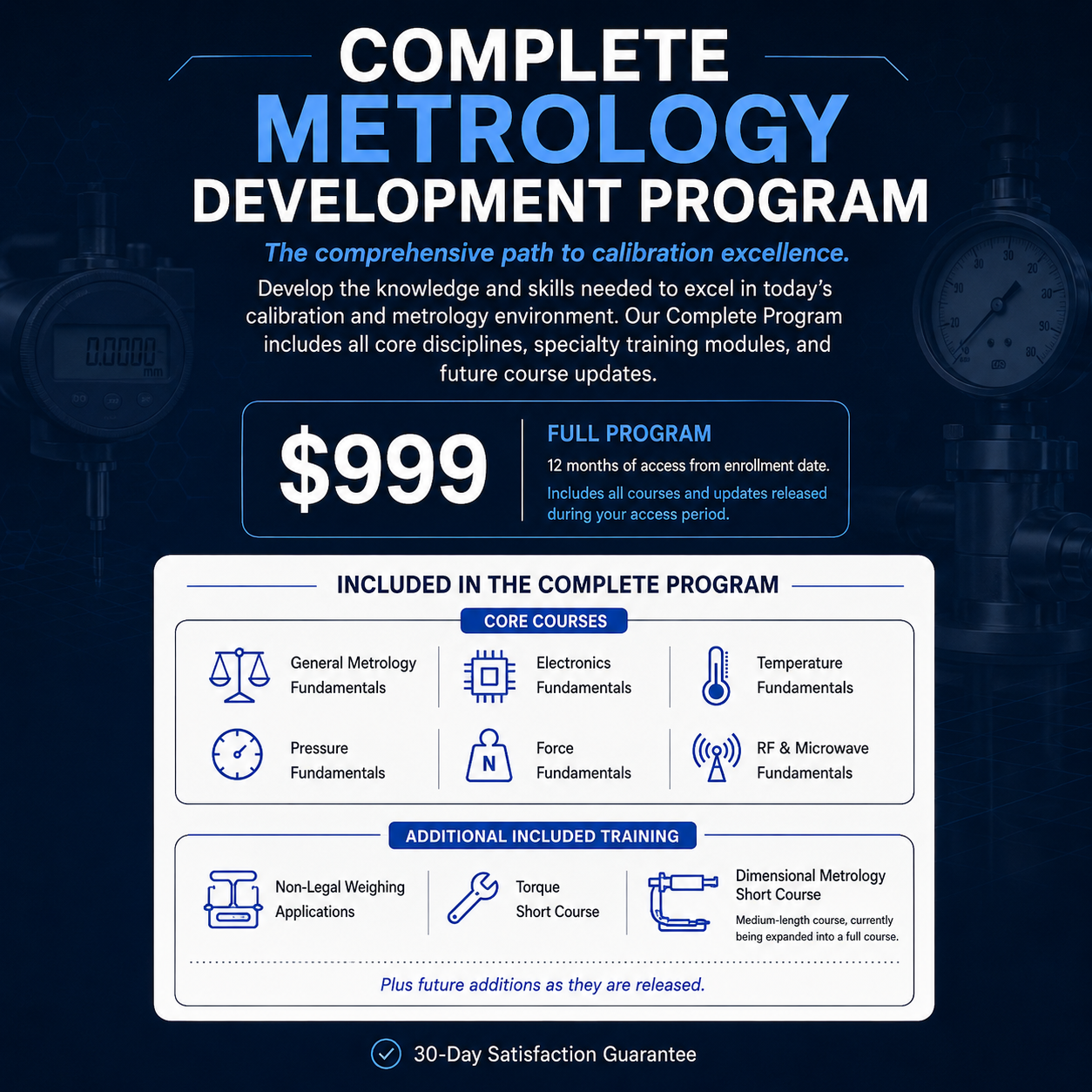
Complete Metrology Development Program
One-Year Online Access
Build a broader foundation across the calibration disciplines most commonly encountered in laboratories, manufacturing environments, process applications, maintenance organizations, and military PMEL programs.
The Complete Metrology Development Program provides one year of access to Sine’s broadest online training pathway. It is intended for new and developing calibration technicians, experienced personnel expanding into additional disciplines, and organizations seeking a structured approach to onboarding, cross-training, and continuing technical development.
Rather than teaching calibration as a series of isolated procedures, the program helps learners understand the measurement principles behind the work—including traceability, instrument behavior, setup decisions, error sources, documentation, troubleshooting, and the conditions that influence measurement validity.
Included Training Areas
The Complete Program includes access to available SCORM courses together with the broader, established Sine Calibration School curriculum.
Core SCORM Courses
General Metrology
Develops the common language and decision framework used throughout calibration, including SI units, significant figures, rounding, tolerance interpretation, error, metrological traceability, documentation, and quality-system awareness.
Electronics for Calibrators
Connects electrical principles to calibration and troubleshooting applications involving voltage, current, resistance, circuits, 4–20 mA loops, transducers, oscilloscopes, process calibrators, and common setup errors.
Temperature Calibration
Covers temperature sensors, reference systems, comparison methods, dry blocks, baths, resistance measurements, thermocouples, RTDs, fixed-point concepts, infrared thermometry, stabilization, immersion, and other factors affecting temperature results.
Pressure Calibration & Metrology
Introduces pressure types, instruments, media, reference systems, comparison calibration, hysteresis, repeatability, return-to-zero behavior, leaks, scaling problems, unstable readings, and structured troubleshooting.
Force Calibration & Metrology
Explores force realization, load-cell behavior, fixtures, alignment, calibration execution, ASTM E74 concepts, hysteresis, rotational testing, data interpretation, and the distinction between repeatable and valid measurements.
Additional Complete-Program Content
The broader Sine Calibration School also includes established and developing content in areas such as:
Dimensional measurement methods
RF and microwave measurement
Torque
Non-legal weighing applications
Supplemental calibration and measurement topics
Availability, depth, assessment format, and delivery method may vary as courses are updated and migrated into the SCORM library. During the current transition period, Complete Program participants receive access to both available SCORM courses and traditional school content not yet incorporated into SCORM.
What Learners Can Expect
Technician-Focused Instruction
Training connects measurement theory to the work technicians perform at the bench, in the laboratory, and in industrial environments.
Practical Calibration Applications
Examples, demonstrations, scenarios, knowledge checks, and review activities reinforce setup decisions, instrument behavior, error recognition, troubleshooting, and interpretation of results.
Flexible Online Access
Learners can progress at their own pace and revisit material throughout the one-year access period.
Structured Development Path
The program can support:
New-technician onboarding
Cross-training into additional measurement disciplines
Refresher training
Laboratory standardization
Continuing professional development
Preparation for supervised laboratory practice
Assessments and Completion Records
Available SCORM courses include structured interactions, knowledge checks, review activities, and graded final assessments. Certificates of Completion, completion records, or digital credentials are provided where applicable.
Applicable Updates
Participants receive applicable course updates released during their active access period, subject to the terms of the program.
Benefits for Learners
Participants can develop:
A clearer understanding of why calibration methods and setups matter
Greater awareness of instrument behavior and common sources of error
Stronger interpretation of specifications, tolerances, and calibration results
Better troubleshooting and measurement-based decision-making habits
More consistent technical communication with supervisors, laboratories, customers, and quality personnel
Benefits for Employers and Laboratories
The program provides a structured educational foundation that can be integrated with laboratory-specific procedures, supervised practice, authorization, and competency evaluation.
It can help organizations establish:
More consistent terminology across technical teams
A common foundation for onboarding and cross-training
Better awareness of setup risks and measurement influences
Stronger connections between procedures and measurement principles
Flexible development without extensive scheduling disruption
The program is particularly suited to calibration laboratories, process and production organizations, quality-driven manufacturers, instrumentation teams, maintenance departments, and military PMEL environments.
Digital Credentials
Successful completion of qualifying courses may include a Certificate of Completion and the opportunity to earn a digital badge or credential recognizing participation and demonstrated understanding within the applicable discipline.
Digital credentials provide a portable and verifiable record of professional development. Availability and requirements vary by course.
Important Competency Notice
Online education supports the development of technical knowledge and contributes to competency development, but course completion alone does not establish full hands-on competence.
Employers and laboratories remain responsible for providing appropriate practical training, supervised experience, observation, competency evaluation, authorization, and ongoing monitoring appropriate to the work performed.
Course Scope and Disclaimer
Sine Calibration & Metrology Training courses are non-degree professional-development offerings. They are intended to supplement—not replace—laboratory procedures, manufacturer instructions, applicable safety requirements, supervised practice, or employer authorization.
Actual completion time may vary according to the learner’s prior knowledge, pace, review needs, and use of optional activities. Course content, assessments, delivery methods, and included materials may be revised as Sine continues developing the SCORM library and broader training program.
The program does not address regulated legal-metrology applications.
Your enrollment will be processed and you will receive an enrollment email from metrologylearning.com within 1-2 business days of purchase. If you have not seen this email within that timeframe, please contact us at support@sinecalibration.com