
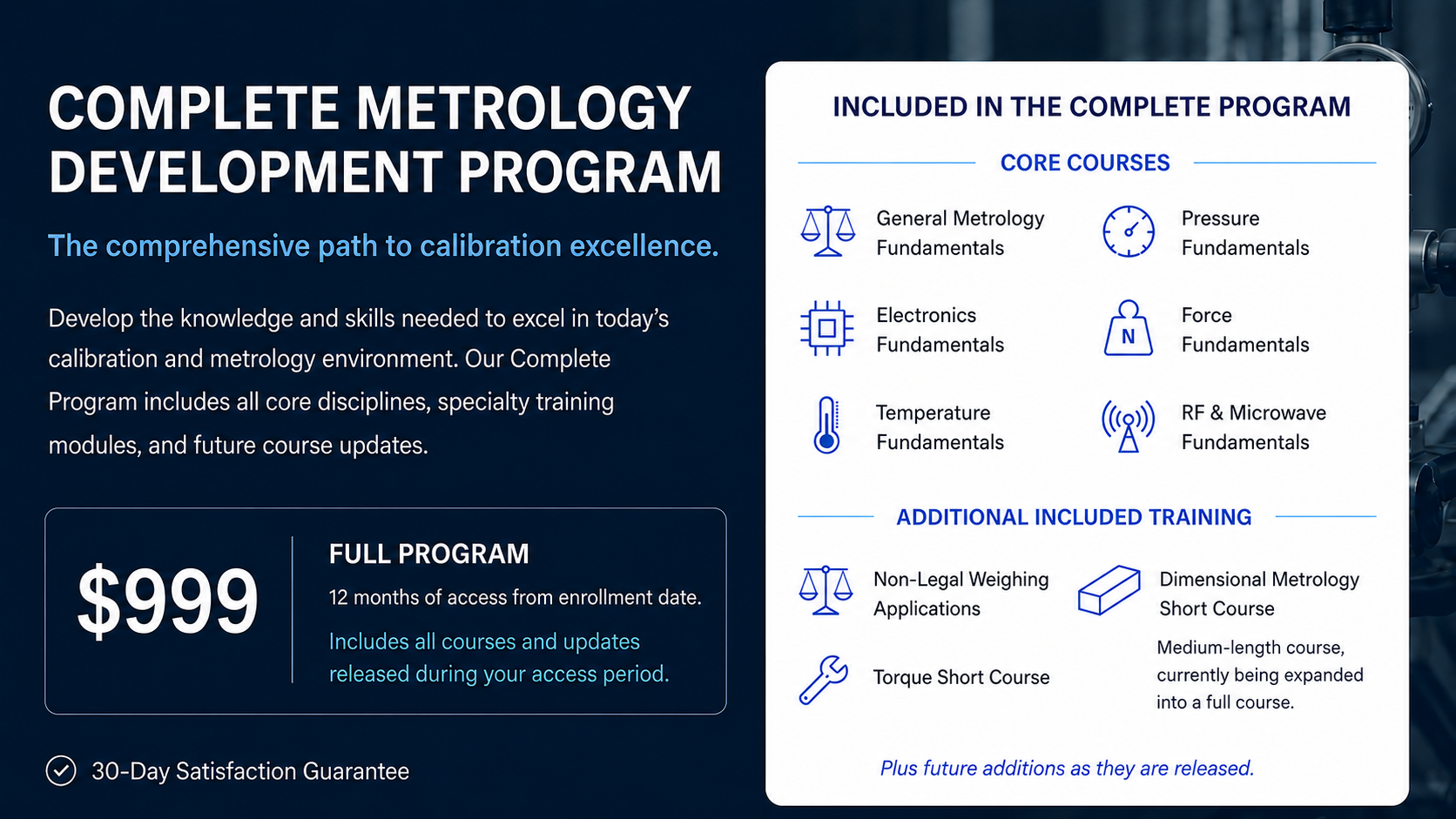
Individual Discipline Packages
Each package includes General Metrology Fundamentals (GM) plus your chosen discipline.
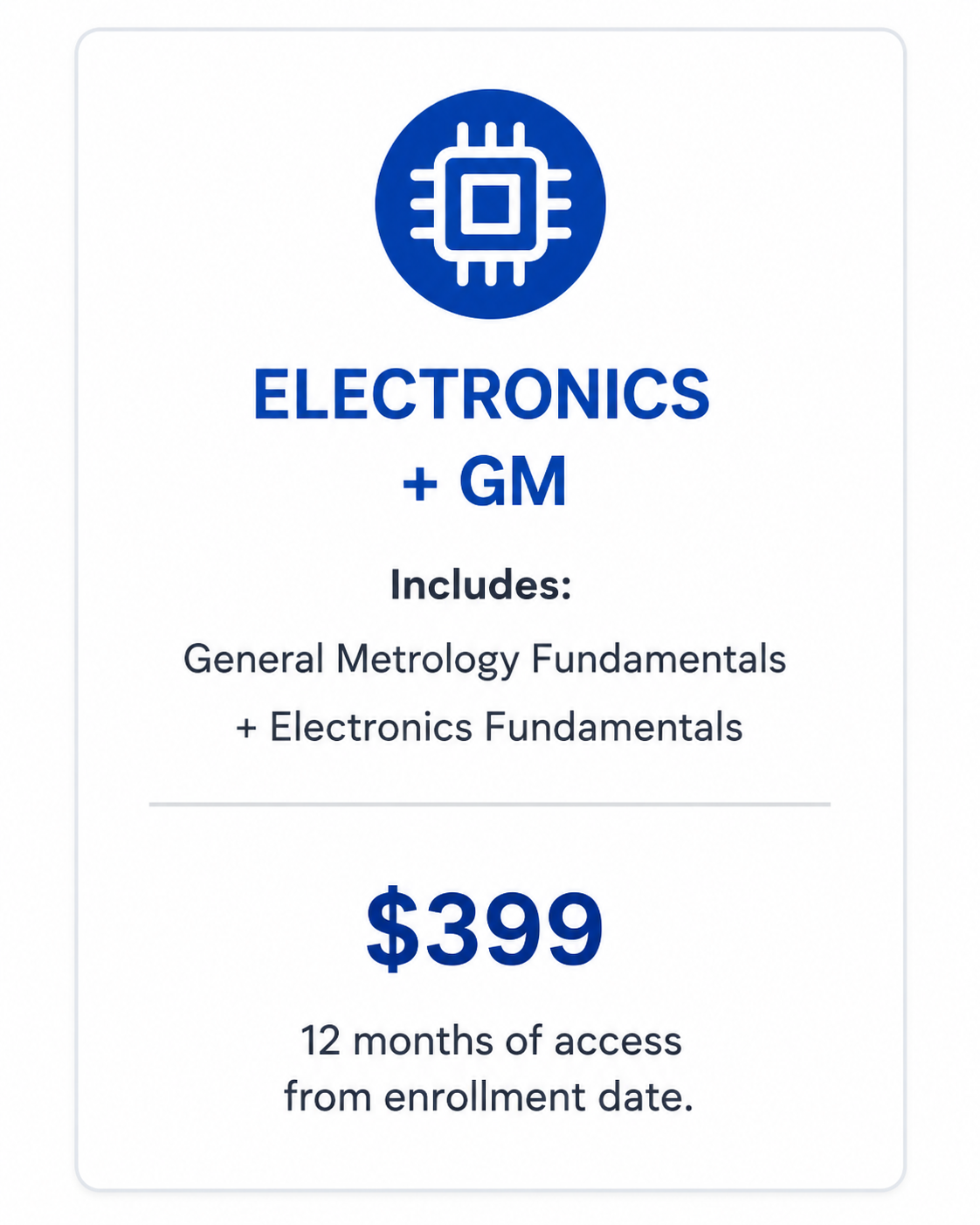
Electronics for Calibrators (EL100)
Electronics measurements are fundamental to modern calibration, yet many calibration technicians receive little formal training in the electrical principles behind the instruments they calibrate every day.
Electronics for Calibrators (EL100) was developed specifically for calibration technicians, metrology professionals, and instrument technicians who need a practical understanding of electronics as they apply to real-world calibration activities.
Rather than approaching electronics from an engineering or design perspective, this course focuses on the concepts technicians encounter at the bench and in the laboratory. Topics include voltage, current, resistance, Ohm's Law, circuit behavior, industrial signal loops, transducers, oscilloscopes, process instrumentation, and multifunction calibration systems.
Throughout the course, learners are introduced to the theory behind electrical measurements while continuously connecting those concepts to practical calibration workflows and troubleshooting situations commonly encountered in calibration laboratories and industrial environments.
Topics covered include:
• Electrical units and measurements
• Voltage, current, and resistance
• Ohm's Law and circuit fundamentals
• Kirchhoff's Current and Voltage Laws
• 4–20 mA loops and industrial instrumentation
• Wheatstone bridges and transducers
• Oscilloscope fundamentals and signal interpretation
• Source versus measure techniques
• Process calibrator applications
• Multifunction calibrator operation and setup fundamentals
• Troubleshooting and best practices for electrical measurements
This self-paced SCORM course combines legacy instructional content with updated learning interactions, knowledge checks, and practical reinforcement designed to improve retention and connect theory to technician workflows.
Whether you are entering electronics calibration for the first time or looking to strengthen your understanding of the measurements behind your daily work, EL100 provides a practical foundation that can be immediately applied in calibration laboratories, manufacturing environments, and industrial facilities.
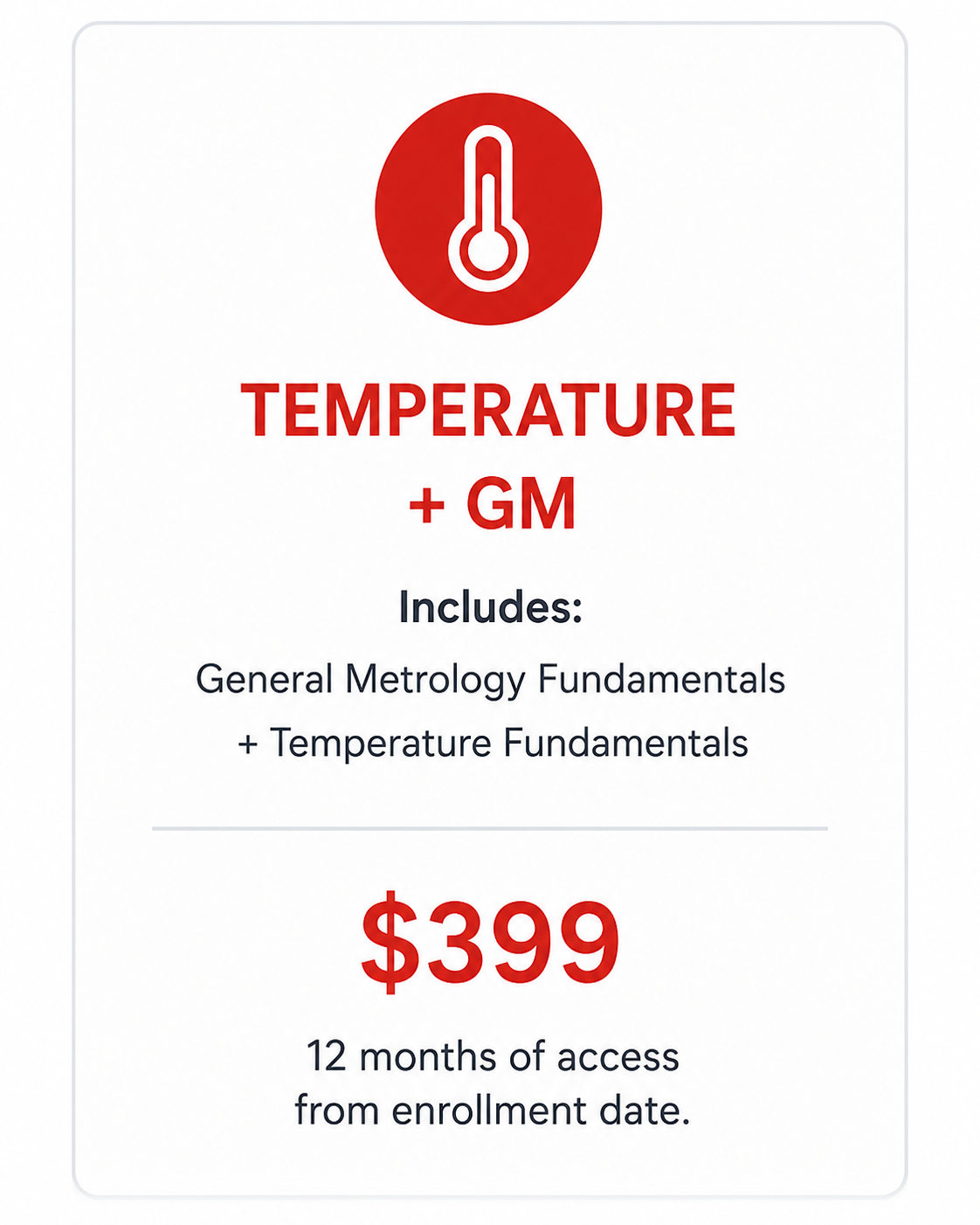
Temperature Calibration (TEMP100)
Temperature measurements influence product quality, process control, safety systems, regulatory compliance, and countless industrial operations. Despite their importance, many technicians receive little formal training in the principles, sensors, and calibration methods that support accurate temperature measurements.
Temperature Calibration (TEMP100) was developed specifically for calibration technicians, metrology professionals, and instrument technicians who need a practical understanding of temperature calibration as it applies to real-world laboratory and industrial environments.
Rather than approaching temperature metrology from a purely theoretical perspective, this course focuses on the concepts technicians encounter during everyday calibration activities. Topics include thermocouples, RTDs, thermistors, comparison calibration methods, dry block calibrators, reference thermometry, fixed-point concepts, and practical considerations that influence measurement quality and calibration validity.
Throughout the course, learners are introduced to the principles behind temperature measurements while continuously connecting those concepts to practical calibration workflows and troubleshooting situations commonly encountered in calibration laboratories, manufacturing facilities, and process environments.
Topics covered include:
• Temperature measurement fundamentals and traceability concepts
• Thermocouple principles and cold junction compensation
• RTDs, PRTs, SPRTs, and thermistors
• Two-wire, three-wire, and four-wire measurement methods
• Comparison calibration techniques
• Dry block and stirred bath calibration methods
• Probe placement, immersion depth, and stem conduction effects
• Reference thermometry and fixed-point concepts
• Triple Point of Water (TPW) awareness and ITS-90 fundamentals
• Source versus measure techniques for temperature instrumentation
• Infrared thermometry considerations and emissivity effects
• Liquid-in-glass thermometer considerations and immersion practices
• Common sources of error and troubleshooting techniques in temperature calibration
This self-paced SCORM course combines legacy instructional content with updated learning interactions, knowledge checks, and practical reinforcement designed to improve retention and connect theory directly to technician workflows.
Whether you are entering temperature calibration for the first time or looking to strengthen your understanding of the measurements behind your daily work, TEMP100 provides a practical foundation that can be immediately applied in calibration laboratories, manufacturing operations, pharmaceutical environments, and industrial facilities.
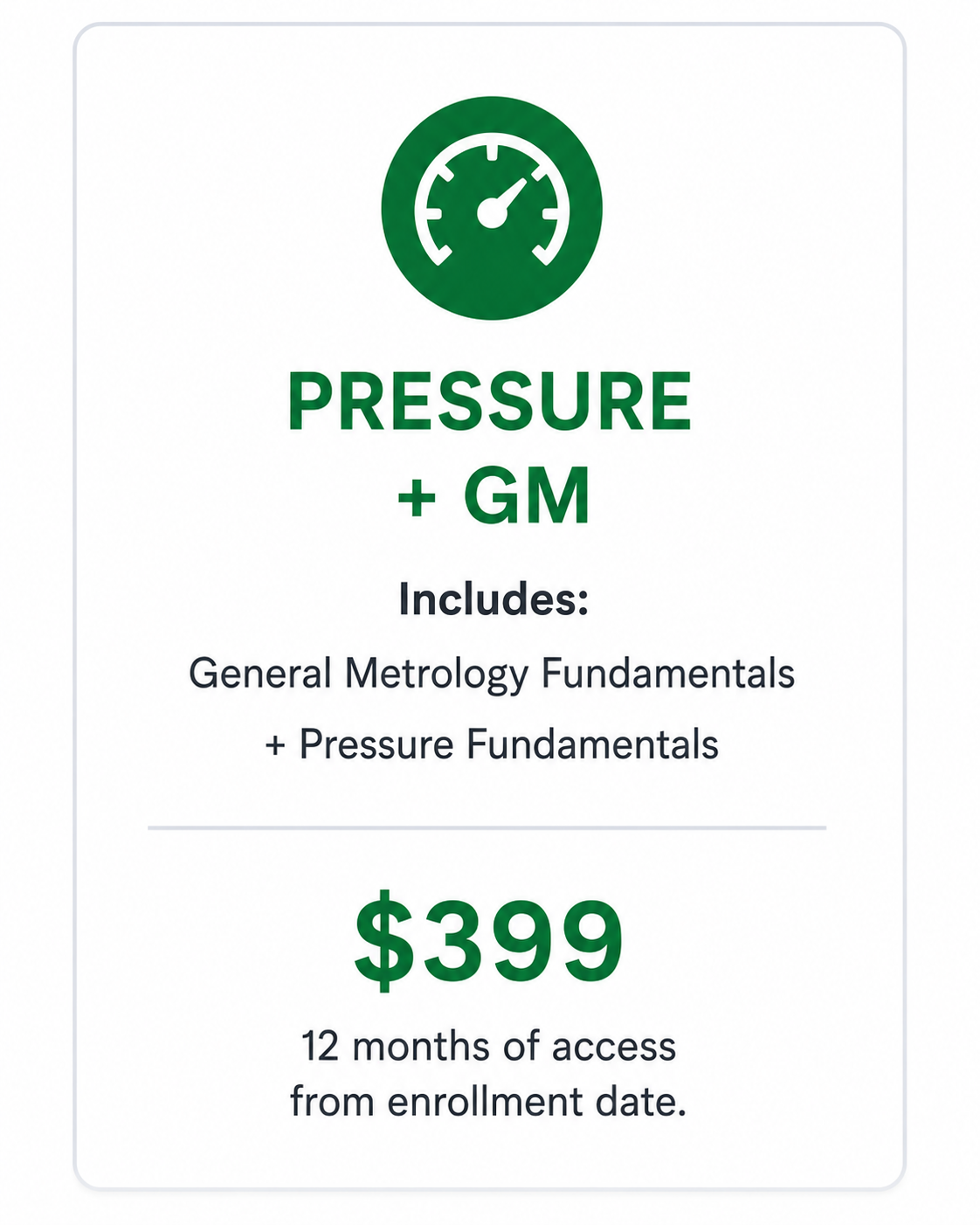
Pressure Calibration and Metrology (PR100)
Pressure is one of the most commonly performed calibration disciplines in industry, yet many technicians receive little formal training in the measurement principles and instrument behaviors that influence the quality of their results.
Pressure Calibration and Metrology (PR100) was developed specifically for calibration technicians, metrology professionals, instrumentation technicians, and quality personnel who need a practical understanding of pressure measurements as they apply to real-world calibration activities.
Rather than approaching pressure from a purely theoretical or engineering perspective, this course focuses on the concepts technicians encounter at the bench, in the laboratory, and in the field. Learners are introduced to the principles behind pressure generation and measurement while continuously connecting those concepts to practical calibration workflows, instrument behavior, and troubleshooting situations commonly encountered in calibration laboratories and industrial environments.
Throughout the course, special emphasis is placed on helping technicians move beyond simply recording values and toward understanding what those values mean. Learners develop the ability to recognize setup issues, identify abnormal instrument behavior, interpret calibration results, and determine when a measurement can be trusted.
Topics covered include:
• Pressure fundamentals and SI units
• Gauge, absolute, vacuum, and differential pressure
• Pressure generation methods and system behavior
• Mechanical pressure devices and Bourdon tube operation
• Electronic pressure transducers and transmitters
• Pressure calibration setup and safety considerations
• Pneumatic versus hydraulic calibration methods
• Pressure media selection and compatibility considerations
• Hysteresis, repeatability, and return-to-zero behavior
• Pressure signal scaling and interpretation
• Analog pressure calibration techniques
• Electronic pressure calibration techniques
• Deadweight tester fundamentals and pressure realization concepts
• Common sources of error in pressure measurements
• Troubleshooting and best practices for pressure calibration
This self-paced SCORM course combines legacy instructional content with updated learning interactions, knowledge checks, practical demonstrations, and scenario-based reinforcement designed to improve retention and build technician confidence during real calibration activities.
Whether you are entering pressure calibration for the first time or looking to strengthen your understanding of the measurements behind your daily work, PR100 provides a practical foundation that can be immediately applied in calibration laboratories, manufacturing environments, process facilities, and industrial operations.
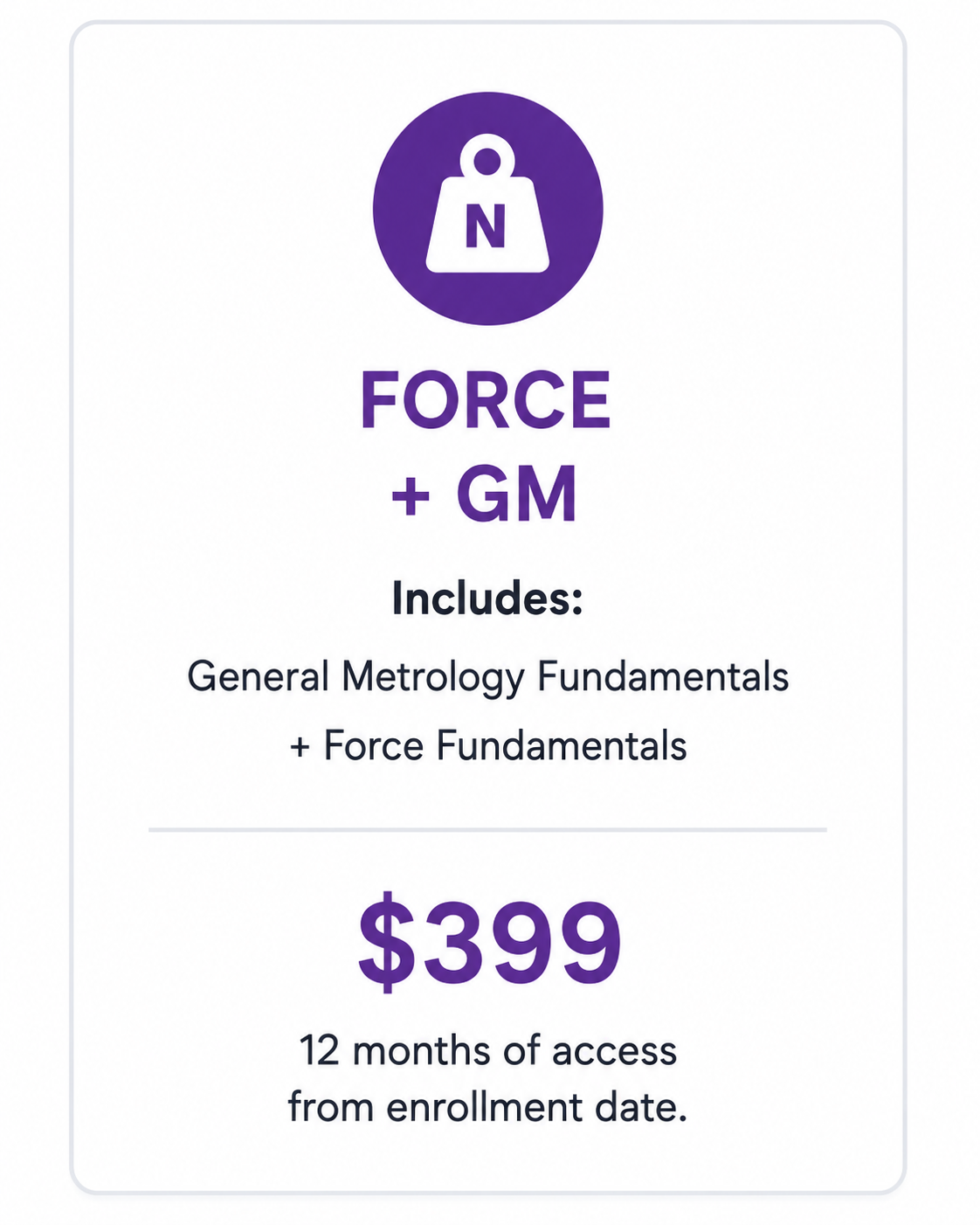
Force Calibration & Metrology (FORCE100)
Force measurement plays a critical role in manufacturing, materials testing, aerospace, medical device production, and industrial quality systems. Despite its importance, many calibration technicians receive limited formal training in how force is generated, transferred, measured, and interpreted throughout the calibration process.
Force Calibration & Metrology (FORCE100) was developed specifically for calibration technicians, metrology professionals, quality personnel, and test technicians who require a practical understanding of force measurements as they apply to real-world calibration activities.
Rather than approaching force measurement from a mechanical engineering or machine design perspective, this course focuses on the concepts technicians encounter in calibration laboratories and testing environments every day. Learners are introduced to the principles behind force realization and measurement while continuously connecting those concepts to calibration workflows, uncertainty considerations, and troubleshooting scenarios commonly encountered in industry.
Throughout the course, students explore not only how force calibrations are performed, but why calibration procedures are structured the way they are. Particular emphasis is placed on understanding how setup conditions, alignment, adapters, and calibration execution influence measurement validity and uncertainty.
Topics covered include:
• Force versus mass and the realization of force
• Traceability and force measurement hierarchy
• ASTM E74 fundamentals and force calibration principles
• Load cell behavior and force measurement systems
• Mechanical loading paths and measurement influence factors
• Alignment, adapters, and force transfer considerations
• Calibration execution and best practices
• Exercise cycles, rotation requirements, and loading sequences
• Ascending and descending measurements and hysteresis effects
• Lower Limit Factor (LLF) and verified ranges of force
• Measurement repeatability versus measurement correctness
• Troubleshooting force measurement systems and identifying common error sources
• Mechanical versus electrical causes of measurement problems
• Practical considerations for maintaining valid force measurements
This self-paced SCORM course combines legacy instructional material with updated learning interactions, knowledge checks, and practical reinforcement designed to improve retention and connect theory directly to technician workflows.
Whether you are entering force calibration for the first time or looking to strengthen your understanding of the measurements behind your daily work, FORCE100 provides a practical foundation that can be immediately applied in calibration laboratories, materials testing facilities, manufacturing environments, and industrial operations where force measurements matter.